June 19, 2026 - Lauren Zheng
Step outside at dusk and look up at the sky. For thousands of years, that specific, deep transitional blue signaled to the human brain that it was time to wind down, trigger melatonin, and prepare for sleep. Now, look at the screen in front of you. The artificial blue light emitting from our devices isn't just messing with our internal biological clocks, it is fundamentally altering our psychological relationship with color itself. We are living in a historic pivot point where our primary interaction with the visual world happens through illuminated pixels rather than reflected pigment, and this shift is quietly changing how we perceive, remember, and emotionally react to art.

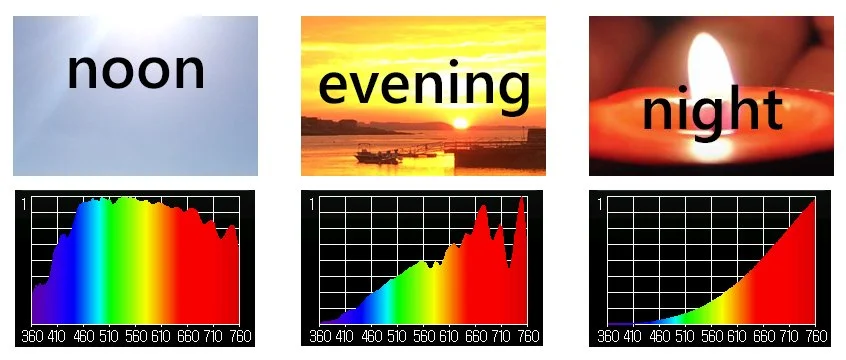
Historically, painters mixed physical materials, crushed lapis lazuli, toxic cobalt, or ground beetles, to trap light on a canvas. The viewer’s eye read that color based on the ambient atmosphere of the room, meaning a painting looked vastly different under morning sunlight than it did by candlelight. It was an organic, unpredictable dialogue between the environment, the chemical makeup of the paint, and the artwork itself. Artists spent lifetimes mastering how to trick
the eye using only the finite spectrum of earth and stone. Today, digital art exists in a state of constant, perfect, unyielding illumination. Because digital screens use an additive color model where colors are literally created by projecting light directly into our retinas, colors like electric cyan, neon magenta, and radioactive green possess a vividness that is physically impossible to achieve with traditional oil or acrylic paint. We are training our brains to expect a level of saturation and brightness that the physical world simply cannot provide.
This hyper-saturation is creating a fascinating disconnect in our visual memory and changing how we experience physical spaces. When we visit a museum to see a classical masterpiece in person, a growing number of people experience a subconscious wave of disappointment. The textures are real, but the colors feel muted, muddy, and flat compared to the backlit, high-contrast versions we swipe past on social media feeds. Our internal color palette is being aggressively recalibrated by software engineers who optimize screen displays for maximum visual dopamine. The art of the past was built on the subtle gradient of shadows and the patience of the human eye, but the art of the present is increasingly built on the aggressive punch of pure luminescence designed to catch a scrolling thumb. We have become accustomed to a baseline of brilliance that makes natural landscapes and traditional galleries feel desaturated by comparison.
Furthermore, this shift alters the very physics of how we process imagery emotionally. When we look at a traditional painting, our eyes are relaxed, catching photons that have bounced off a textured surface. It is an active form of looking that requires us to decode layers of depth and brushwork over time. When light is projected directly at us from a screen, the experience becomes passive and sensory-heavy. The brain is flooded with immediate stimulation, shortcutting the slow, contemplative absorption that art historically demanded. We aren't just changing our aesthetic preferences; we are rewriting the neural pathways that dictate attention spans and emotional resonance.
Ultimately, this forces us to reexamine what it means to truly "see" art in the modern age. Designers and digital artists aren't just creating compositions anymore; they are manipulating raw photons to command attention in an incredibly
crowded digital landscape. They are working with a palette of pure energy rather than physical matter. As the boundary between natural sight and synthetic illumination continues to blur, the true canvas is no longer a physical wall or even a sheet of glass, it is the human mind itself, leaving us to wonder what happens to our appreciation of the physical world when reality no longer feels bright enough.